
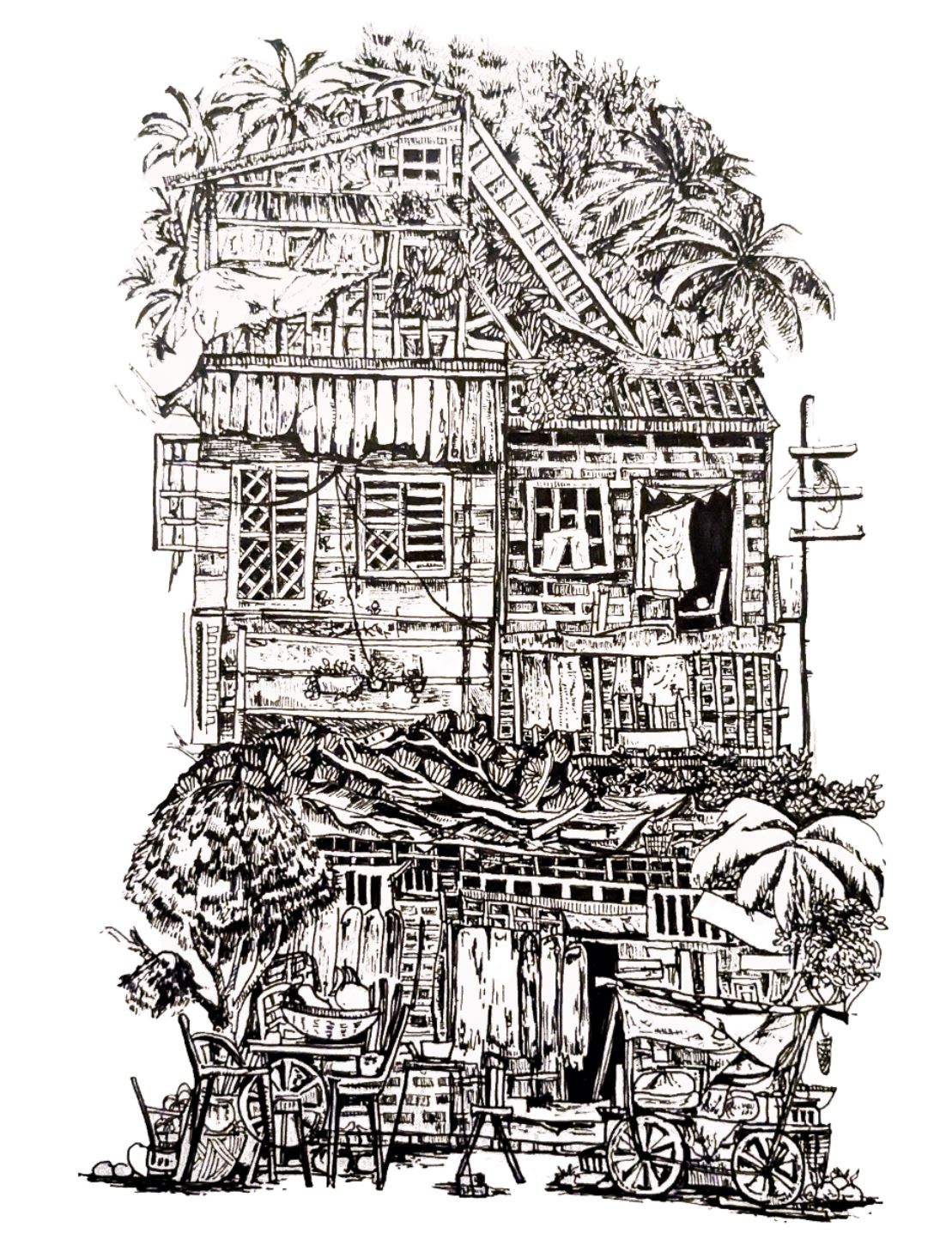
Exactly a hundred hummed film songs, a hearty lunch, and a filter-coffee ride from Bangalore, India lay Ajja’s house in Gokarna. A timber shell, tilted and stitched together like a half-remembered lullaby.
Its materials made no promises: louvres stuck half-opened, shutters groaning and creaking, and the front yard doubling as a dining room and beach kiosk. Yet, there was choreography in the clutter—trousers swaying beside papayas and wires curling like calligraphy in the salty air.
I hadn’t yet studied vernacular architecture, but this was its most genuine expression: an honest façade with no façade at all, a patch-worked geography of kin, tide, and frugal improvisation. And for every summer since childhood, it became my temporary home.
About the Artist: Manasa Vinodkumar

Manasa is an interdisciplinary artist working at the intersection of cities, patterns, and everyday human behaviour. Her work explores the invisible systems that shape how we move, wait, meet, and misread spaces - often using humour, structure, and gentle observation rather than spectacle.
With a background in architecture and urban research, Manasa is interested in moments that fall outside official maps: wrong turns, quiet rituals, fleeting connections, and the unintended choreography of daily life. Her practice spans visual work, storytelling, and participatory experiments, treating the life as both a canvas and a collaborator.
She is drawn to projects that are playful yet rigorous, intimate yet collective - finding meaning not in grand monuments, but in the small, human glitches that make places feel alive.
